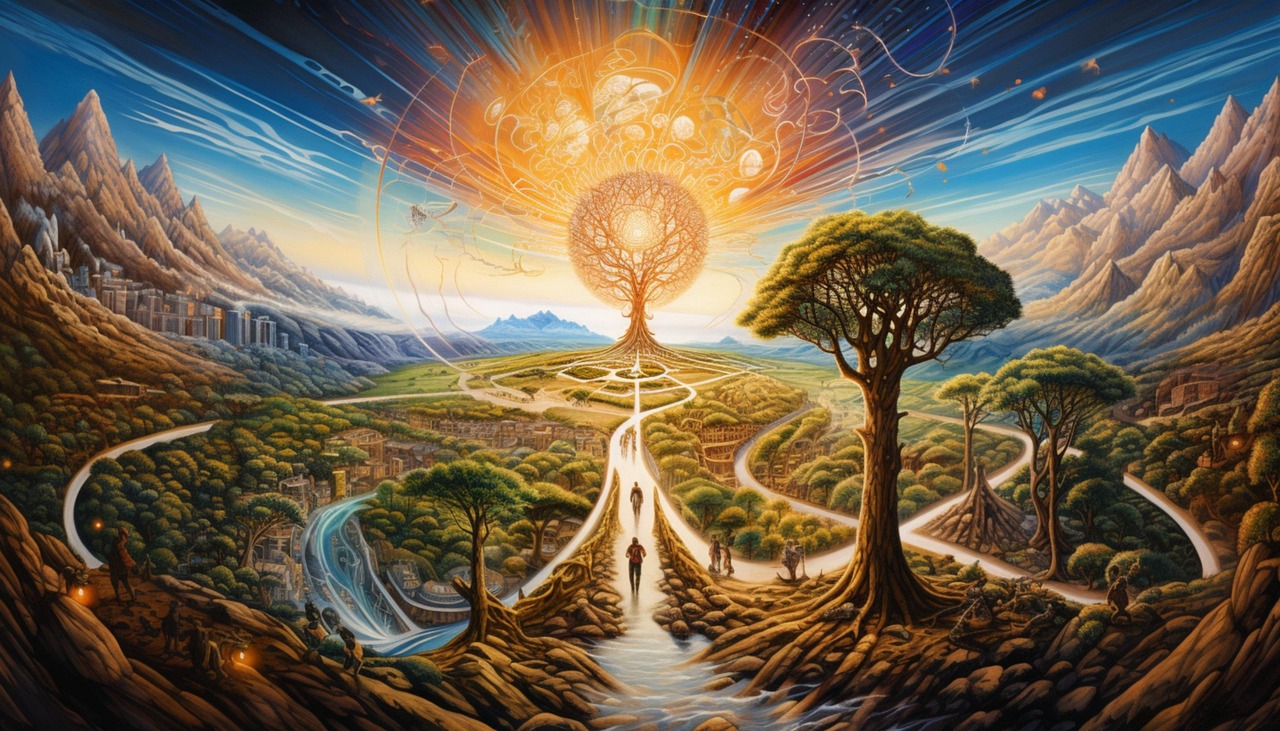
In the age of Artificial Intelligence, why reaffirm the relevance of Gyan Yoga, the ancient art of knowledge?
Because, although established thousands of years ago, Gyan Yoga’s mystical doctrine, spanning the ancient Indian philosophical scriptures, offers answers to questions which seekers, philosophers, mathematicians, rationalists and visionaries have searched for since time immemorial. Questions such as who we are, what our identity and purpose are, what the nature of the world and of consciousness is, what karmas are, what the illusion of ignorance and what its pitfalls are, amongst others, continue to plague modern men and women.
For the post-truth post-pandemic world, Gyan Yoga’s illuminating truths and transcendent tenets offer discovery, meaning, unity and acceptance, as they clarify the goal of existence, essence of creation, nature and duty of man, identity of all identities and such lustrous truths with an analytical, philosophical and rational outlook. Traversing the realms of spirituality and science, myth and memory, they invite seekers across age, gender, caste, creed and sect to pursue knowledge as a sacred quest for truth and transcendence. Let’s examine its impact on decision-making.
Decision-making and Knowledge- Mahabharata
Decision-making has always been complicated by a multitude of factors in the personal and professional space. What should influence the process- Family or Community? Personal need or group goal? Duty or pleasure? Dharma or adharma? Shreya or preya? Shreya is the dutiful or higher outlook, while Priya is the easier or lower outlook. Let’s travel back to the distant past with the epic Mahabharata and examine a momentous decision. Before the great war broke out between the Kauravas and the Pandavas, Karna, a celebrated warrior, the son of Kunti and half-brother of the Kauravas, was presented with two conflicting choices-
²Shreya (righteous action)- To join the dharmic war of the Pandavas
²Preya (desirable action)- To stand by his adharmic friend Duryodhana
Although a noble warrior, this set of choices clouded his intellect and, consumed by strong emotions, he chose to discharge his duty towards the friend. On the face of it, it appeared to be a principled decision- supporting a loved one was dutiful, admirable, but unbeknownst to him, performing the dharma was paramount. In the grand scheme of things, he landed on the side of adharma, thanks to a misplaced sense of loyalty, and suffered defeat along with the non-righteous Kaurava clan. Very clearly in this example, the one who acted without wisdom suffered while the ethical were victorious and continue to be revered after thousands of years.
In hindsight, it appears unexacting to arrive at this conclusion, but personal equations and strong emotions can make the decision-making process go awry. Gyan Yoga states that Dharma or righteousness, the worthy companion of knowledge and an outlook of shreya, should guide the decision-making process. It may be challenging, but regular reflection on the nature of knowledge, on the nature of shreya and dharma will enhance awareness, build conviction and strengthen resolve.
Emotion and Knowledge- Ramayana
Another example of the clash of emotion and wisdom can be found in the pages of the revered Ramayana. Before the great war between Lord Rama and the king of Lanka, Ravana, the Lankan princes had two choices:
²Shreya (righteous)- To join the dharmic war against Ravana
²Preya (desirable)- To fulfil the fraternal duty to Ravana
Prince Kumbhakaran chose to support his brother, believing it was the right thing to do-it was both a familial duty and a royal duty to the king of Lanka. When the younger prince Vibhishan persuaded him to change his decision, he refused his counsel, although he was aware Ravan had committed a heinous sin by abducting Goddess Sita. Vibhishan chose to discharge his dharma, and although labelled a traitor, it was he who was proven right eventually. For he was driven by Shreya and stood up against a tyrant, while Kumbhakaran was driven by Preya. This obfuscated his decision-making, forcing him to ignore the facts of the situation and the impending suffering of the innocent Lankan people due to the war foisted upon them by their king. After the victory of good over evil, it was Vibhishan who was anointed the King of Lanka, while Kumbhakaran and Ravan perished.
To summarize, the sacred union of dharma and knowledge supersedes the ego, the individual, time and even destiny- it is guaranteed to triumph over adharma and must support decision-making in this era of instability and uncertainty.
A Timeless Outlook: A Clarifying Approach
Clearly, the transformative journey of knowledge offers clarity and frees one from the vice-like grip of ignorance and the illusory chokehold of false ego. The alternative is to fall prey to the shape-shifting nature of ignorance. The many wars burning within and in multiple parts of the world, both online and offline, are symptomatic of the meteoric rise of ignorance, an irony considering this is the enlightened Age of AI. Great seekers, inspiring intellectuals, transformative yogis and powerful change-makers, both ancient and modern, like Buddha, Saint Kabir, Gargi, Swami Vivekanand, Nelson Mandela, Gandhi and many others, fought against divisive ignorance and accepted the pursuit of knowledge as the irrefutable call of destiny. Their stirring, impactful life journeys into the heart of consciousness stand as testaments to the universality, relevance and empowering potential of Gyan yoga. They inspire the world to follow in their footsteps and imbibe knowledge as a deeply sacred act of self and collective liberation, and as an integral step towards a new era of peace and progress.
About the Author
Richa Tilokani holds a Master’s degree in Business Administration (MBA) from SP Jain Institute of Marketing & Research, Mumbai and is an author and poet who started out as a marketing and advertising professional.


